Chord Progressions Every Guitarist Should Know
Chord progressions form the harmonic backbone of countless songs across pop, rock, and blues. For guitarists, understanding these sequences is essential for playing in a band, writing original music, or simply jamming with friends. While there are thousands of possible chord combinations, a handful of progressions appear repeatedly in Western music. Recognizing these patterns allows musicians to learn songs faster, anticipate changes, and communicate more effectively with other players.
This article explores some of the most common chord progressions in pop, rock, and blues. It provides diagrams to illustrate the shapes and offers practical tips for smooth chord transitions. Whether you are a beginner or an experienced player, familiarity with these progressions can expand your musical vocabulary and enhance your playing. The focus is on understanding the structure and context of each progression, not on prescriptive rules.
It is important to note that musical application depends on various factors, including style, tempo, and personal interpretation. The information here serves as a general guide. For guitarists using platforms like Fretstream, these concepts can be integrated into practice routines and creative exploration.
Understanding Chord Progressions
A chord progression is a series of chords played in succession, forming the harmonic foundation of a song. In Western music, progressions are often built around the diatonic scale, where each chord has a specific function. The Roman numeral system is commonly used to analyze progressions, with uppercase numerals for major chords and lowercase for minor chords. For example, in the key of C major, the I chord is C, the ii chord is D minor, the V chord is G, and so on.
The function of each chord within a key contributes to the sense of tension and resolution. The I chord typically serves as the home base, while the V chord creates tension that often resolves back to I. The IV chord provides a sense of departure, and the vi chord adds emotional color. Understanding these functions helps guitarists navigate progressions and make informed choices about voicings and rhythms.
While theory provides a framework, progressions are also shaped by genre conventions and cultural context. Pop music tends to favor simple, repetitive progressions that support vocal melodies. Rock often incorporates power chords and modal interchange, while blues relies on a distinct 12-bar structure with dominant seventh chords. Each genre has its own idiomatic patterns that guitarists should become familiar with.
Common Pop Progressions
Pop music is known for its accessible and catchy chord progressions. The I–V–vi–IV progression is perhaps the most ubiquitous, appearing in countless hits across decades. In the key of C major, this translates to C–G–Am–F. This progression is popular because it is easy to play, sing over, and loop. It creates a balanced emotional arc, moving from stability (I) to tension (V) to melancholy (vi) and then to a sense of lift (IV).
Another common pop progression is the vi–IV–I–V, which is essentially the same chords in a different order. This progression starts on the minor vi chord, giving it a slightly sadder tone before resolving to the major I. It is often used in verses and choruses to create contrast. The ii–V–I progression, while more common in jazz, also appears in pop ballads, adding a touch of sophistication.
To play these progressions smoothly, guitarists should focus on efficient finger placement and minimal movement. Using barre chords or open chords depends on the desired tone and playability. For example, the I–V–vi–IV in G major (G–D–Em–C) can be played with open chords, making it accessible for beginners. Practicing transitions between these chords slowly with a metronome can help build muscle memory. Fretstream offers tools that can assist in tracking progress and refining technique.
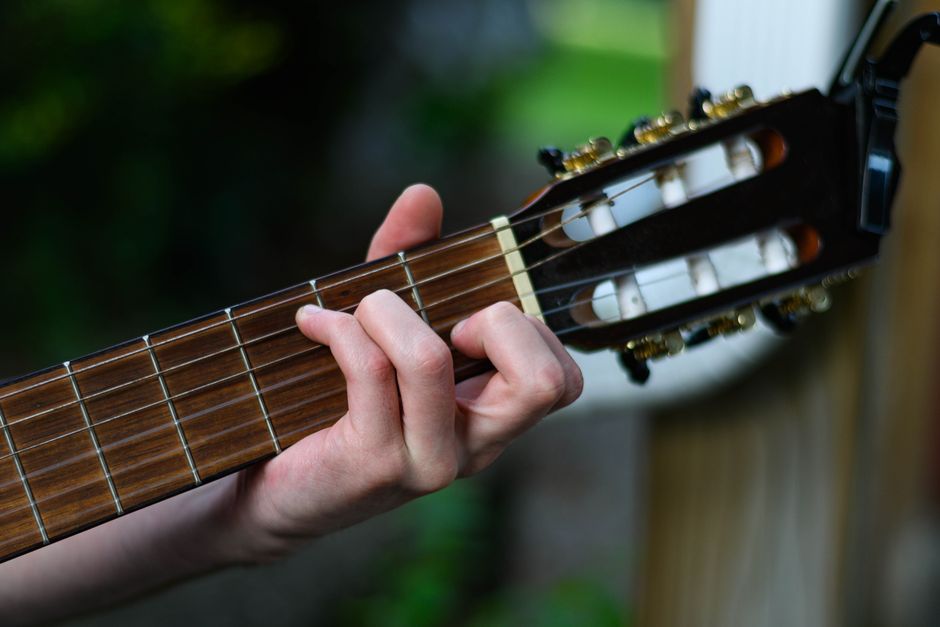
Diagrams for these progressions typically show chord grids with finger numbers. For instance, a C major chord diagram indicates placing the third finger on the third fret of the A string, the second finger on the second fret of the D string, and the first finger on the first fret of the B string. Similar diagrams for G, Am, and F chords help visualize the shapes. When transitioning, keep fingers close to the strings to reduce travel distance.
Essential Rock Progressions
Rock music often employs progressions that emphasize power and energy. The I–IV–V progression, fundamental to rock and roll, appears in songs like “Wild Thing” and “La Bamba.” In the key of A, this is A–D–E. This progression is straightforward and lends itself to distortion and rhythmic drive. The V chord creates tension that resolves to the I, providing a satisfying cadence.
Another staple is the I–bVII–IV progression, which has a modal, slightly rebellious feel. In the key of E, this would be E–D–A. This progression is common in classic rock and grunge. It often uses power chords, which are easier to move around the fretboard. The bVII chord adds a Mixolydian flavor, distinguishing it from standard diatonic progressions.
The vi–IV–I–V progression also works well in rock, especially in power ballads and anthems. The i–bVII–bVI progression in minor keys, such as Am–G–F in A minor, is another powerful sequence used in hard rock and metal. These progressions benefit from palm muting, aggressive strumming, and dynamic contrast.
Achieving smooth transitions in rock often involves using barre chords or power chords that share common shapes. For example, moving from an E5 power chord (root on the low E string) to a D5 power chord (root on the A string) requires a shift in hand position, but the shape remains the same. Practicing these shifts with a steady rhythm is key. Fretstream can be a useful resource for accessing backing tracks and exercises that target these movements.
Blues Progressions and Variations
The blues is built on a 12-bar structure that typically uses three chords: the I, IV, and V, all played as dominant seventh chords. In the key of A, the basic 12-bar blues progression is four bars of A7, two bars of D7, two bars of A7, one bar of E7, one bar of D7, and two bars of A7. This progression forms the basis for countless blues songs and improvisations.
Variations of the 12-bar blues include the quick change, where the IV chord is played in the second bar, and the slow change, where it appears in the fifth bar. Other variations involve substituting chords, such as using a ii–V turnaround instead of the standard I–V. The blues is also characterized by the use of shuffle rhythms, where eighth notes are played with a triplet feel.
Guitarists playing blues often use open chords or barre chords with added sevenths. For example, an A7 chord is played with the root on the fifth fret of the low E string, or as an open chord. Smooth transitions in blues rely on anticipating chord changes and using walk-ups or walk-downs to connect chords. These bass lines add movement and interest.
Diagrams for blues chords show the added seventh, such as the A7 shape with fingers on the second fret of the D, G, and B strings. Practicing the 12-bar form with a metronome at a slow tempo helps internalize the structure. Fretstream provides a variety of blues backing tracks in different keys and tempos, which can aid in developing a feel for the progression.
Tips for Smooth Chord Transitions
Smooth chord transitions are essential for musicality, regardless of genre. One effective technique is to visualize the next chord shape before moving. This mental preparation reduces hesitation and allows for a more fluid change. Another tip is to keep fingers close to the fretboard when lifting them, minimizing unnecessary motion.
Using anchor fingers—fingers that stay on the same string and fret across multiple chords—can simplify transitions. For example, when switching between C and Am, the first finger on the B string stays in place. Similarly, when moving between G and Em, the first finger on the A string can remain. Identifying these anchors can significantly improve efficiency.
Practicing with a metronome at slow tempos builds precision. Start with a comfortable speed and gradually increase. It is also helpful to practice the transitions themselves in isolation, without strumming, to focus on finger placement. Once the movement feels natural, add rhythm and dynamics.
Finally, be patient and consistent. Progress may vary depending on individual factors such as hand size, finger strength, and practice routine. There is no universal timeline for mastery. Incorporating these tips into regular practice, perhaps with the support of tools like Fretstream, can lead to gradual improvement.
“The guitar is a small orchestra. Every string is a different color, a different voice.” — Andrés Segovia
This quote reminds us that each chord and transition contributes to the overall texture of the music. By understanding common progressions and applying thoughtful techniques, guitarists can bring these colors to life in their playing.